https://beyondmonet.com/20-facts-about-claude-monet/
https://www.muma-lehavre.fr/fr/expositions/monet-au-havre
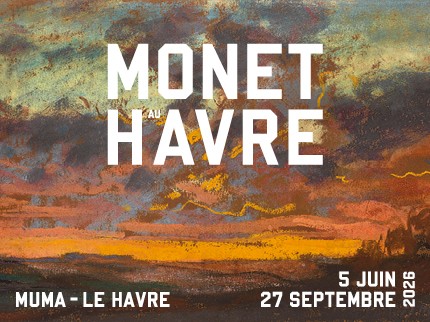
Monet in Le Havre
from June 5th to September 27th, 2026
>>> ONLINE TICKETING <<<To mark the centenary of Claude Monet's death (Paris, 1840 – Giverny, 1926), the MuMa presents a unique exploration of the painter's early life through the exhibition "Monet in Le Havre."From his first sketchbooks to his maritime and port landscapes, the exhibition reveals how these thirty pivotal years, spent between Le Havre and Paris, shaped Monet's vision and technique.Featuring nearly one hundred works and documents from prestigious public and private institutions, as well as from the collections of the artist's descendants, the exhibition offers a fresh perspective on the connection between the father of Impressionism and the city of Le Havre.
A YOUTH FROM LE HAVRE 
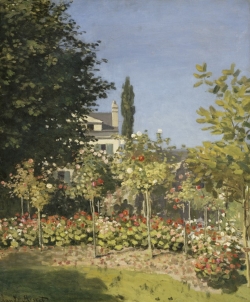
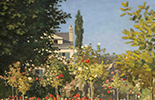
Claude Monet (1840-1926), Garden in Bloom - at Sainte-Adresse , circa 1866, oil on canvas, 64 x 53 cm. Montpellier - Musée Fabre. On loan from the Musée d'Orsay - Paris. © RMN-Grand Palais (Musée d'Orsay) / Hervé Lewandowski
The MuMa exhibition offers a sensitive and in-depth exploration of Claude Monet's early years in Le Havre, from 1845 – when his family settled in the port city – to 1874, the date of the first Impressionist exhibition in Paris, which coincided with the execution of his last series of Le Havre seascapes. These three decades were marked by the awakening and affirmation of his vocation.Born in 1840, the young Monet took his first artistic steps in Le Havre. He filled his sketchbooks with drawings made from life, playfully sketching the city's notables, learning landscape painting alongside Eugène Boudin and then Johan Barthold Jongkind, absorbing the lessons of the masters, and composing his first still lifes. Dividing his time between his childhood city and Paris, where he met the future Impressionists, Monet gradually honed his vision and asserted his ambition.In Le Havre, he also encountered photographers, drawn by the picturesque subjects or the technical challenges offered by a rapidly changing maritime city. Their images formed a reservoir of motifs that permeate his work. From the wild landscapes of Pointe de la Hève in Sainte-Adresse, this "end of the world" prized by the people of Le Havre, to the regattas enlivening the harbor, and even to the heart of the great industrial port, the canvases painted in Normandy tell the story of the birth of a painter and a modern vision.HIS FIRST SUPPORTERS 
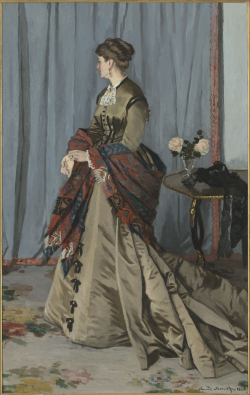
Claude Monet (1840-1926), Madame Louis Joachim Gaudibert , 1868, oil on canvas, 216.5 x 138.5 cm. Paris - Musée d'Orsay. © Grand Palais Rmn (Musée d'Orsay) / Hervé Lewandowski
It was in Le Havre that Monet found his supporters. Within his own family, his brother Léon Monet encouraged him; among local collectors, the Gaudibert family acquired his first paintings. Later, the founders of the Cercle de l'Art Moderne—Olivier Senn, Pieter Van der Velde, and Charles-Auguste Marande—became regular buyers. Through his friends Eugène Boudin and Gustave Courbet, the young artist further expanded his circle of patrons and solidified his place on the art scene.Based on previously unseen documents, the exhibition presents the artist's family background, life in Le Havre and its decisive influence, the young painter's sources of inspiration, the conditions of his training, his numerous caricatures, the sites he chose to depict, the evolution of his technique, and the essential role of his early collectors. A detailed chronology, maps of the region, and excerpts from correspondence—often presented for the first time—offer invaluable insight into the genesis of a body of work and the journey of an artist destined to transform the history of painting.THE EXHIBITION'S LAYOUT 
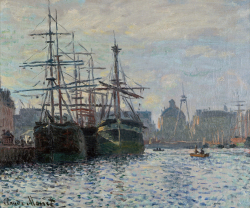
Claude MONET (1840-1926), The Commerce Basin, Le Havre , circa 1874, oil on canvas, 37 x 45 cm. Liège - La Boverie. © Musée des Beaux-Arts de Liège/La Boverie
The MuMa exhibition is divided into 10 sections according to a thematic and chronological logic and includes around one hundred works including paintings, Monet's sketchbooks, archival documents and numerous family photographs.The exhibition will shed new light on the Monet family, the Le Havre milieu with its notables caricatured by the young artist, and the many artistic influences:1. Growing up in Le Havre2. The first sketchbooks in 1856 and the first painting in 18583. Monet and still life4. Caricatures, Le Havre-Paris5. Monet and Boudin's pastel skies6. Gustave Le Gray and photographers in Le Havre in 18567. Seascapes and harbor scenes8. Patrons in Le Havre9. Monet's donation to the City of Le Havre, 191010. Water Lilies #1 and #2 by Ai Weiwei, 2022.A contemporary garden.AI WEIWEI, WATER LILIES #1 AND #2, 2022
A CONTEMPORARY GARDEN 
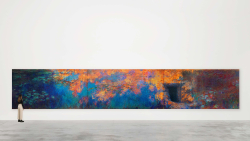
Ai Weiwei, Water Lilies #1 , 2022, Lego. San Gimignano - Galleria Continua. Courtesy AI WEIWEI STUDIO and GALLERIA CONTINUA. © Ela Bialkowska
In collaboration with the Normandy Impressionist Festival 2026, the MuMa presents, for the first time in France, two installations by the Chinese artist and activist Ai Weiwei.Monumental, each over fifteen meters long, these works, composed of 650,000 LEGO® bricks, reinterpret Claude Monet's Water Lilies . During his years in New York, Ai Weiwei spent considerable time contemplating this painting at MoMA, absorbing its luminous vibrations.From this memory emerged a unique reinterpretation, where the industrial and mass-produced nature of the colored bricks replaces the Impressionist brushstrokes, without betraying their meditative spirit. Butthese Water Lilies are also a filial gesture. The works pay homage to his father, a poet trained in Paris, who studied there and was deeply influenced by Impressionism, before being silenced by the communist regime upon his return to China. 
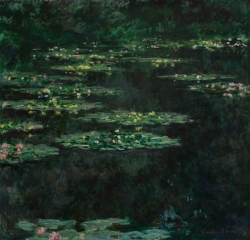
Claude Monet (1840-1926), Water Lilies , 1904, oil on canvas, 89 x 93 cm. Le Havre - André Malraux Museum of Modern Art - gift of the artist - 1910. © MuMa Le Havre / David Fogel
Presented at the MuMa, these two monumental works open and close the exhibition, engaging in dialogue with the 1904 Water Lilies painting, given by Monet to the City of Le Havre in 1910. They also mark Ai Weiwei's first visit to Normandy, following in Monet's footsteps, inscribing this confrontation between East and West, past and present, in the very land that gave birth to Impressionism.
No comments:
Post a Comment